
AEO vs SEO: Optimizing for the Age of AI Search
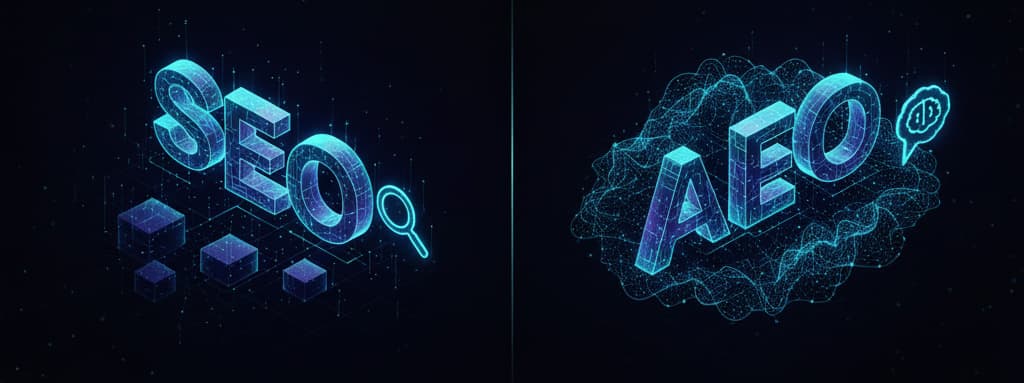
The way people find information online is changing. While traditional search engines still dominate, AI-powered answer engines like ChatGPT, Perplexity, Claude, and Google's AI Overviews are reshaping how users discover and consume content. This shift demands a new optimization strategy: Answer Engine Optimization (AEO).
What is AEO?
Answer Engine Optimization (AEO) is the practice of optimizing your content to be selected and cited by AI systems when they generate answers to user queries. Unlike traditional SEO, which focuses on ranking in search results, AEO focuses on being the source that AI models reference when synthesizing responses.
SEO vs AEO: The Fundamental Difference
The core distinction lies in what you're optimizing for:
| Aspect | SEO | AEO |
|---|---|---|
| Goal | Rank on search result pages | Be cited in AI-generated answers |
| Success Metric | Click-through rate, rankings | Citation rate, source attribution |
| Content Format | Keywords, meta tags, backlinks | Structured data, factual accuracy, authority |
| User Interaction | User clicks through to your site | User may never visit your site |
| Competition | 10 blue links on page 1 | 1-3 sources cited per answer |
The AI Citation Funnel
When an AI answer engine processes a query, it goes through several stages to select which sources to cite:
- Query Understanding - Parsing user intent
- Knowledge Retrieval - Searching indexed content
- Source Evaluation - Assessing authority and relevance
- Answer Synthesis - Combining information from multiple sources
- Attribution - Citing the most authoritative sources
Key AEO Ranking Factors
While the exact algorithms are proprietary, research and testing have revealed several factors that influence AI citation:
1. Structured Data (JSON-LD)
AI systems heavily rely on structured data to understand content. Schema.org markup helps machines parse your content accurately.
Critical schema types for AEO:
Article- For blog posts and newsFAQPage- For question-answer contentHowTo- For instructional contentOrganization- For brand informationProduct- For e-commerce
2. E-E-A-T Signals
Google's E-E-A-T framework (Experience, Expertise, Authoritativeness, Trustworthiness) applies even more strongly to AEO:
3. Content Clarity and Structure
AI models prefer content that is:
- Directly answerable - Clear, concise responses to questions
- Well-structured - Headers, lists, tables
- Factually accurate - Verifiable claims with sources
- Up-to-date - Current information with publication dates
4. Semantic Completeness
Rather than targeting specific keywords, AEO rewards topical completeness. Cover a subject comprehensively rather than optimizing for individual search terms.
Traffic Impact: SEO vs AEO
One of the biggest concerns with AI answer engines is the potential for "zero-click" answers—where users get their information without ever visiting your site.
The good news: while traditional search traffic may decline, AI referral traffic is growing. Sites that are frequently cited by AI systems often see:
- Higher quality traffic - Users who click through are more engaged
- Brand authority - Being cited builds credibility
- New discovery channels - AI systems introduce users to sources they'd never find via search
Practical AEO Implementation Checklist
Technical Foundation
- Implement comprehensive JSON-LD structured data
- Ensure fast page load times (AI crawlers have timeouts)
- Use semantic HTML5 elements (
<article>,<section>,<aside>) - Create an XML sitemap with lastmod dates
- Enable proper robots.txt access for AI crawlers
Content Strategy
- Answer questions directly in the first paragraph
- Use the "inverted pyramid" writing style
- Include relevant statistics with sources
- Update content regularly with visible timestamps
- Cover topics comprehensively (topical authority)
Authority Building
- Secure quality backlinks from authoritative sources
- Get cited in academic papers and research
- Build author credibility with bylines and bios
- Maintain consistent NAP (Name, Address, Phone) data
- Earn mentions in trusted publications
Content Format Comparison
Different content formats perform differently across SEO and AEO:
The Future: Convergence of SEO and AEO
Looking ahead, the line between SEO and AEO will blur. Search engines are increasingly incorporating AI-generated answers, while AI systems are improving their ability to crawl and index the web.
What this means for content creators:
- Quality over quantity - One excellent piece outperforms ten mediocre ones
- Facts over opinions - Verifiable information gets cited more
- Structure over style - Clear organization beats clever writing
- Authority over novelty - Established expertise trumps trendy takes
Measuring AEO Success
Unlike SEO, AEO metrics are still evolving. Here's what to track:
Emerging AEO Metrics
- Citation Rate - How often AI systems cite your content
- Source Position - Where you appear in multi-source answers
- Query Coverage - What percentage of relevant queries cite you
- Brand Mentions - Unprompted AI mentions of your brand
- Referral Quality - Engagement from AI-referred visitors
Tools for AEO Monitoring
- Monitor AI answer engines directly for your target queries
- Track referral traffic from AI platforms (Perplexity, ChatGPT, etc.)
- Use structured data testing tools
- Analyze search console for AI-generated query patterns
Conclusion: Embrace Both SEO and AEO
The rise of AI answer engines doesn't mean SEO is dead—it means optimization is evolving. The most successful content strategies will:
- Build for humans first - Great content serves both search engines and AI
- Invest in structure - Schema markup and clear organization pay dividends
- Prioritize accuracy - Factual, well-sourced content gets cited
- Stay adaptable - The landscape is changing rapidly
The websites that thrive in this new era won't choose between SEO and AEO—they'll master both. Start by ensuring your technical foundation supports AI discovery, then focus on creating authoritative, well-structured content that answers real questions.
The age of "10 blue links" is giving way to the age of synthesized answers. Position your content to be the source those answers come from.